
How Pleasanton Busted Arrests Move
Pleasanton tops Atascosa County's city list. The 2020 Census put 10,648 people there. Local arrests go through the Pleasanton Police Department, run by Chief Ernest Guerra and Assistant Chief Anastacio Perez. An arrest that leads to county detention usually sends the person to the Atascosa County Jail in Jourdanton. That split shapes your whole search. The city keeps the street-level incident or arrest report. The Atascosa County Sheriff's Office, or ACSO, holds the county booking record and any photo it may release. County dispatch also works with several other law-enforcement partners. So the agency named on an arrest record may not be the office holding the person after transport. Write down the event date, the arresting agency, and any booking or case number before you call anyone. For what a charge became, the answer sits with the court, not the arrest report.
Where Busted Mugshots Appear
Hunting for a daily arrest log or mugshot feed from Pleasanton? The city's official pages offer no such thing. No blotter, no bookings view, no public photo gallery. The ACSO official page takes the same approach, posting no online jail roster or booking-photo results. Absence online does not mean no record exists. It just means the request has to go through the proper channels, and any third-party site should be treated as a sideshow rather than the main event.
| Channel | What it covers | Access and limits |
|---|---|---|
| Pleasanton Police Department | City-held incident and police records | Official city route, with no public daily arrest or photo feed identified. |
| ACSO and Atascosa County Jail | County intake, in-custody, release, and jail-record questions | Official county route. No public online roster or booking-photo display was identified. |
| District Clerk and district dockets | Later district-court case activity | Official post-booking verification, not a jail photo source. |
| TDCJ, BOP, and ICE | State-prison, federal, and immigration custody systems | Separate official systems, not a combined Atascosa County roster. |
| Pleasanton Express and KSAT | Dated local or regional reporting | Secondary leads only. Confirm agency attribution, status, and dates with the custodian. |
| Mugshots.com | Atascosa County aggregation | Unofficial third-party page, not a Pleasanton Police or ACSO feed. |
For anyone just booked or currently held, ask the county jail. ACSO lists extensions for booking, inmate information, and jail records. It posts no online search schedule, photo fee, or removal policy. A phone call or written request beats trusting an unofficial page as a live roster. The sheriff lists two daily release windows, though those are operational details, not promises about when an online record updates. Reach the Atascosa County Sheriff's Office at 1108 Campbell Avenue in Jourdanton, TX 78026. The main line is 830-769-3434. Extension 2239 handles jail records. Extension 2231 covers booking and inmate information. Extension 2243 takes report and open-records questions. Those separate lines let you ask a county jail question directly, rather than assuming Pleasanton Police keeps that intake file. After a state-prison sentence, the search moves to the TDCJ locator. Federal and immigration cases live elsewhere, in the BOP and ICE locator systems. A hit or a miss in one tells you nothing about the others.
Busted in Pleasanton: Lookup
Build a short, dated trail instead of trusting a single search result. The Atascosa County hub gathers every county-wide record path in one place, and the steps here keep each piece of a Pleasanton arrest tied to the office most likely to hold it.
- Start with the arresting agency. If the event began with Pleasanton Police, note the incident date, location, and the fact that the city agency was involved. Those details help separate a city report from a county booking record.
- For county detention, contact ACSO about the Atascosa County Jail. Its published phone tree lists booking and inmate information at extension 2231 and jail records at extension 2239. Ask for an existing record and identify the requested date range.
- Send a written booking-record or photograph request to reports@acso-tx.org. If the responsive record may be held elsewhere in county government, the county PIA route is pia@co.atascosa.tx.us. Ask for a fee estimate before charges are incurred and request only records that already exist.
- Check the court path after intake. The District Clerk and the 81st and 218th district dockets can help verify later case activity. Court information may arrive after a booking record and may use a different case label.
A strong request names the person, gives the arrest date, and identifies the arresting agency. Then ask for specifics: the booking record and booking number, intake date and time, charges as booked, bond details, release notation, and any photograph the office can release. Expect limits. A custodian may redact or withhold items under state law. No office has to create a record it never kept. Asking for the closest thing that exists often works better than assuming every field lives in one system.
Custody changes fast. A news story or third-party listing cannot tell you who is in the Atascosa County Jail right now; confirm present status with ACSO and case outcomes with the court.
Pleasanton Police Records
For anything the city itself holds, go through the Pleasanton open-records portal. That covers police reports, dispatch material, and other municipal records. E. Rodriguez serves as Records Manager for the department. The city FAQ sets a $6 fee for public incident and accident reports, and notes that reports typically take three to ten days to finish. Those numbers apply to city paperwork only. They say nothing about the price or release rules for a county booking photograph, which rests with the sheriff.
Pleasanton Police Department
704 W. Oaklawn
Pleasanton, TX
830-569-3869
Fax: 830-569-4613
Records Manager: E. Rodriguez
A Pleasanton police report lives with the city, and that matters when you ask. Describe the event you want documented. Then request the existing municipal record through the city's portal, which operates under the Texas Public Information Act. Keep expectations realistic. Not every detail in a report is releasable to the public. For jail intake, a booking number, or a photo the agency can share, start with ACSO instead, since the county jail holds those files. Splitting a request between both offices makes sense when a city officer made the arrest and the county handled the booking. One more wrinkle: the Pleasanton Police FAQ says the department will not release warrants or criminal-history information, so treat neither as part of a city lookup.
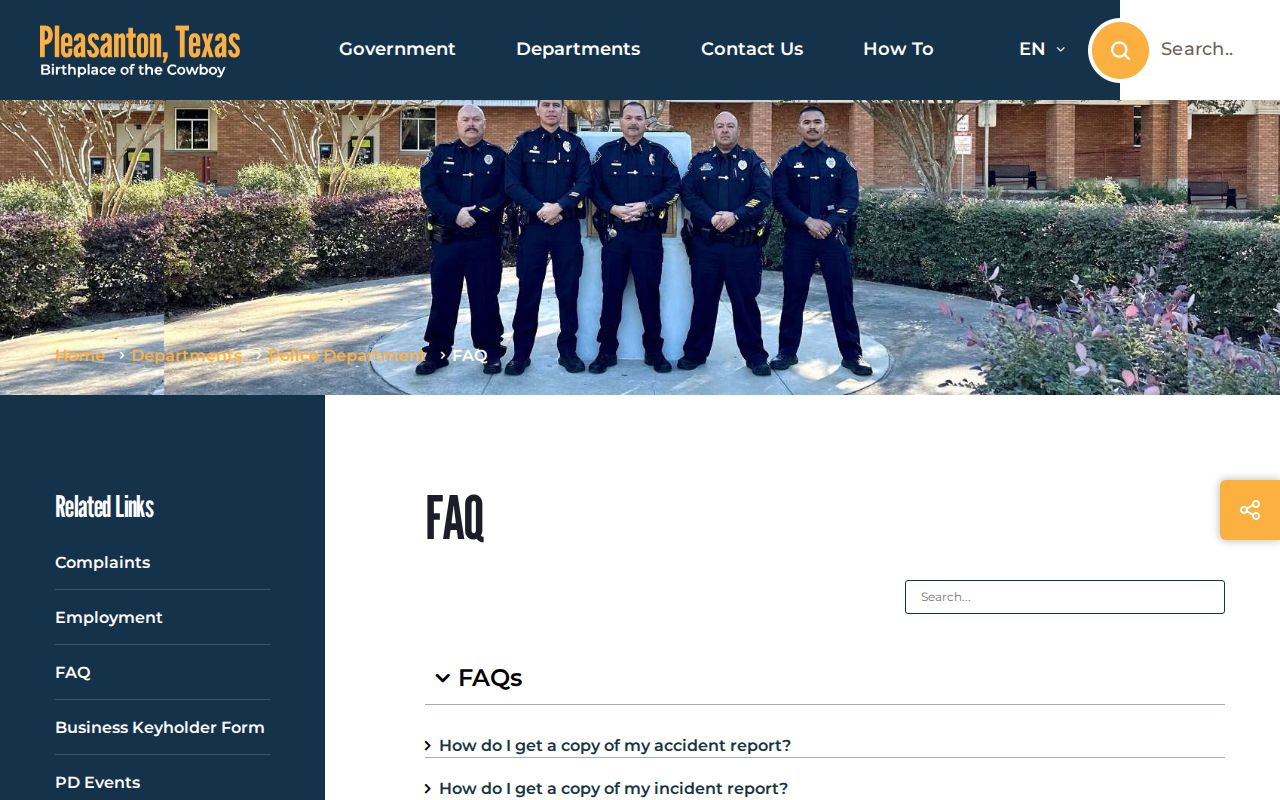
The FAQ draws a line between two different requests. One is a city police report through Pleasanton. The other is a county booking record held by the jail. It routes you to the right office; it is not itself an online arrest log.
City Reports and County Custody
For context, Texas reporting credited Pleasanton Police with 454 adult arrest reports in 2024. That number describes reports, not people. It is not a live booking count, a set of photos, or a public roster. Each arrest can leave a paper trail in three places. The city record covers the event itself. ACSO holds the detention side at the Atascosa County Jail once the person is booked in. The court file carries whatever happens later. Reading one of those as the whole story is the easiest way to get confused, so keep the three sources straight.
No city booking window or online photo policy for Pleasanton was published. No set update schedule exists either. ACSO does post release windows at 8:00 a.m. and 10:00 p.m., though that reflects jail operations rather than online posting times. Someone released from custody may still have a booking record on file. Getting it simply means going through the proper request channel.
From AC to CRD
Atascosa County's local rules explain something that trips up a lot of searches. An arrest creates paperwork fast. The booking officer logs the time of arrest. That officer then sends a duplicate booking record into the magistrate and court process. Here's the tricky part. A felony starts life under an AC Arrest Case number. After indictment, the same matter gets a CRD number instead. Same case, two labels. Search only one label and you may miss the later court entry entirely, even though both records describe the same matter.
- AC Arrest Case
- The local felony identifier used at the arrest and booking stage.
- CRD number
- The district-court case identifier used after indictment.
- Disposition
- The later court result, which gives needed context beyond an charge at booking.
Want to dig deeper? The District Clerk offers an online index with limited image previews. The district court site adds docket information plus weekly PDFs. The local rules also set a clock. A magistrate must see an arrestee no later than 48 hours after arrest. That rule explains a common puzzle. A booking record, a docket entry, and a final outcome can each carry a different date. These paths all come after booking. So before treating two entries as the same matter, compare the agency, the dates, and the case numbers.
Busted News Leads
News stories can point you toward the right agency. That is their real value. A KSAT piece about a Pleasanton gym case shows how this works in practice. The story names the city department involved, says the man went to the Atascosa County Jail, and credits the booking photo to ACSO. Hang onto those details. The date, the agency attribution, and the photo credit all help you trace an arrest back to its source rather than relying on the article alone.
For ongoing coverage, the Pleasanton Express News section is the best local newspaper option. Keep in mind that a weekly paper runs on its own schedule, so a story may lag behind the actual arrest date or trail a regional outlet that updates continuously.
Need a broader view? The Atascosa County crime news page pulls together wider media coverage. One caution applies to aggregators. The Mugshots.com Atascosa page has no official tie to ACSO or the Pleasanton Police, so treat anything found there as a lead and confirm it against agency and court records.